Agar aap JEE Advanced syllabus ki taiyari kar rahe hain, toh aapko pata hoga ki ye sirf ek exam nahi, ek emotion hai. Lekin emotions se rank nahi aati, rank aati hai Syllabus ki gehrai (Depth) samajhne se.
IIT Roorkee ne confirm kiya hai ki 2026 ka syllabus 2025 jaisa hi rahega. Iska matlab rules wahi hain, bas khiladi (aspirants) naye hain. Aaj hum surface-level baatein nahi karenge. Hum baat karenge har chapter ke andar chhupe un topics ki jahan se IIT questions “pick” karta hai.
Taiyaar ho? Let’s dive deep!
1. Physics: The Concept Playground
Physics in Advanced is not about $v = u + at$. It’s about why the frame of reference is accelerating while the object is rotating!
A. Mechanics (The Foundation)
Mechanics is the heart of Physics. Agar ye hil gaya, toh puri building gir jayegi.
- Kinematics: Projectile motion on inclined planes, Relative motion in 2D (Rain-man, River-boat problems).
- Laws of Motion & Friction: Pseudo forces in non-inertial frames, Banking of roads with friction, Pulley-block systems with multiple constraints.
- Work, Energy, Power: Vertical circular motion, Potential energy curves ($U$ vs $r$ graphs), Conservative vs Non-conservative forces.
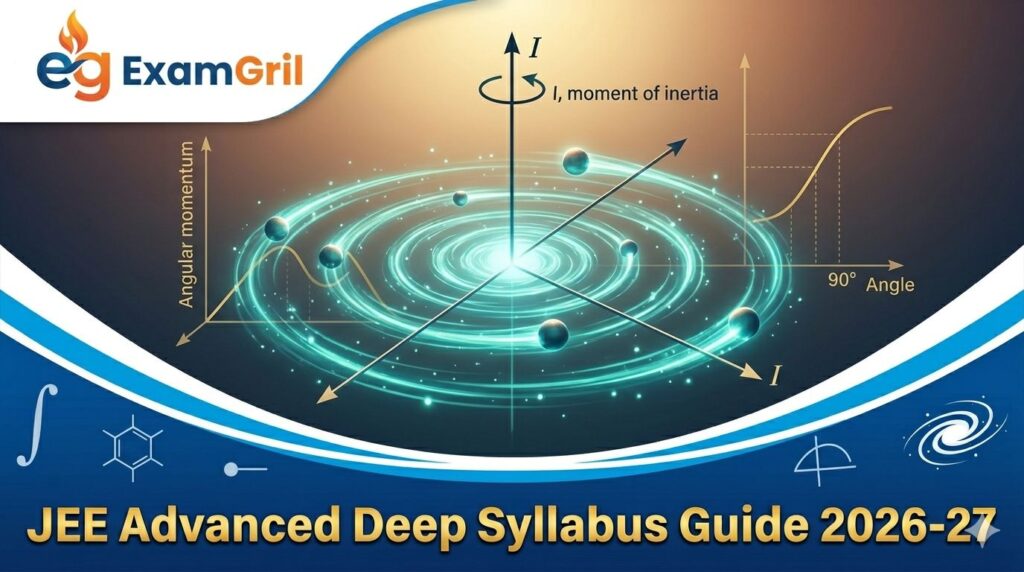
- Rotational Dynamics (The Nightmare): Fixed axis rotation, Rolling without slipping, Angular momentum conservation in complex collisions, Moment of inertia of non-uniform bodies.
- Gravitation: Gravitational self-energy, Kepler’s laws derivation, Escape velocity from different planet configurations.
B. Electromagnetism (The Heavyweight)
- Electrostatics: Gauss’s Law applications in non-symmetric shells, Dipole-dipole interactions, Dielectric polarization.
- Capacitance: Energy density, R-C circuits (Charging/Discharging with multiple batteries).
- Magnetism: Biot-Savart Law for complex loops, Cyclotron motion in combined E and B fields, Hysteresis and Magnetic properties.
- EMI & AC: Motional EMF in rotating rods, Self and Mutual induction, L-C oscillations, Power factor in AC.
C. Optics & Modern Physics (High ROI)
- Ray Optics: Lens-mirror combinations, Silvering of lenses, Optical instruments (Telescope/Microscope) magnifying power.
- Wave Optics: YDSE with thin films, Diffraction at single slit (Qualitative), Polarisation by Brewster’s Law.
- Modern Physics: Bohr’s model for Hydrogen-like atoms, X-rays (Moseley’s Law), Radioactivity (Parallel and Successive decay), Photoelectric effect (Stopping potential vs Frequency graphs).
2. Chemistry: The Memory-Logic Hybrid
Chemistry ko log “ratta” bolte hain, lekin Advanced mein bina logic ke ek reaction bhi nahi hilegi.
A. Physical Chemistry (Numerical Dominance)
- Atomic Structure: Quantum numbers, Probability density plots ψ2 vsr, Heisenberg’s uncertainty principle.
- Chemical Bonding: VSEPR theory (Shapes of XeF4, IF7, Hybridization in complex ions, Molecular Orbital Theory ().
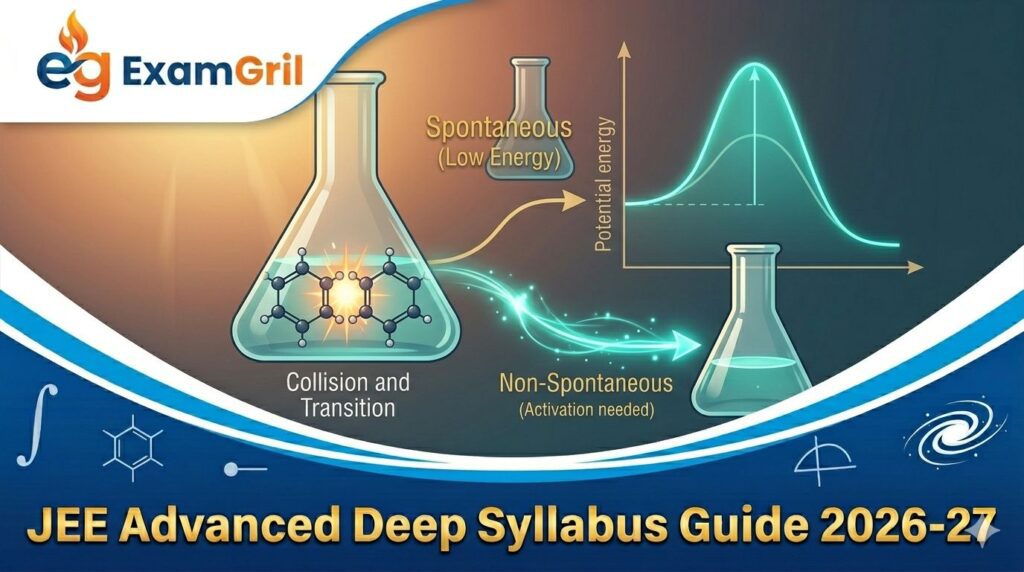
- Thermodynamics & Thermochemistry: 1st and 2nd laws, Entropy change for phase transitions, Gibbs free energy ΔG and Spontaneity.
- Electrochemistry: Nernst equation in concentration cells, Faraday’s laws, Kohlrausch’s law for weak electrolytes.
- Kinetics: First-order reactions, Half-life calculations, Arrhenius equation and Activation energy.
B. Organic Chemistry (The Mechanism Game)
- GOC & Isomerism: Stability of intermediates (Carbocations, Free radicals), Optical isomerism (R/S nomenclature), Tautomerism.
- Reaction Mechanisms: SN1, SN2, E1, E2 (The holy grail), Electrophilic Aromatic Substitution (Nitration, Friedel-Crafts).
- Named Reactions: Reimer-Tiemann, Kolbe, Aldol Condensation, Cannizzaro, Hoffmann Bromamide.
- Biomolecules: Structures of Glucose (Haworth projection), Peptide bonds in proteins, DNA/RNA basics.
C. Inorganic Chemistry (The Scoring Zone)
- Coordination Compounds: IUPAC naming, Werner’s theory, VBT and Crystal Field Theory (Splitting in Octahedral/Tetrahedral).
- p-Block Elements: Compounds of Nitrogen, Phosphorus, Sulfur, and Halogens. Focus on structures (Oxoacids).
- Metallurgy: Ellingham diagrams, Froth floatation, Cyanide process for Silver/Gold.
3. Mathematics: The Endurance Test
Maths is the subject that separates the “Qualifiers” from the “Toppers.”
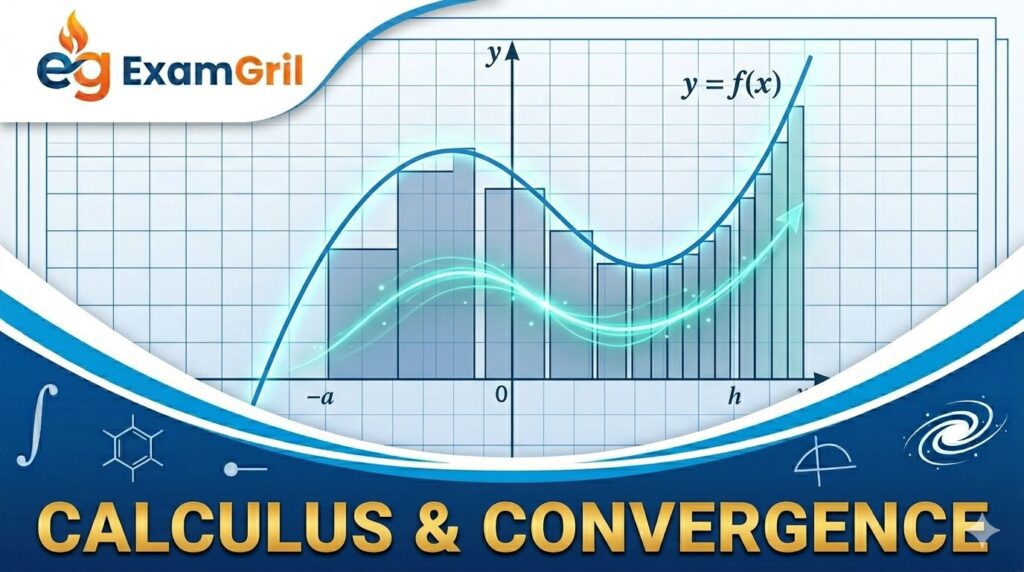
A. Calculus (The King)
- Differential Calculus: Continuity and Differentiability of piecewise functions, Rolle’s and LMVT, Maxima/Minima in 3D-ish scenarios.
- Integral Calculus: Definite integration as a limit of sum, Properties of integrals (King’s Rule), Area under curves (Parabola + Line, Circle + Parabola).
- Differential Equations: Linear differential equations, Variable separable method, Homogeneous equations.
B. Algebra (The Pillar)
- Complex Numbers: De-Moivre’s theorem, nth roots of unity, Geometry of complex numbers (Circles, Lines in Argand plane).
- Matrices & Determinants: Solution of linear equations (Cramer’s rule), Properties of Adjoint and Inverse matrices, Cayley-Hamilton theorem.
- Probability: Bayes’ Theorem, Bernoulli trials, Binomial distribution.
C. Coordinate Geometry & Vectors
- Conic Sections: Tangents and Normals for Parabola, Ellipse, and Hyperbola. Focus on “Common Tangent” problems.
- Vectors & 3D: Scalar Triple Product (STP), Vector Triple Product (VTP), Shortest distance between skew lines, Equation of planes.
Thought from the ExamGril End
“JEE Advanced ki taiyari ek marathon hai, sprint nahi. Humne ExamGril par dekha hai ki jo students sirf syllabus finish karne ke piche bhagte hain, wo aksar conceptual depth miss kar dete hain. Humara vision hai ki har aspirant ko ye samajh aaye ki ‘How to think’ is more important than ‘What to know’. Syllabus ka har ek topic ek chabi hai jo IIT ka darwaza khol sakti hai. Use dhyan se pakdiye.” — ExamGril Editorial Team
Frequently Asked Questions (FAQs)
Q1: Kya JEE Advanced 2026 ke syllabus mein koi naya topic add hua hai? Nahi, IIT Roorkee ne confirm kiya hai ki syllabus 2025 wala hi rahega. Koi major change nahi hai.
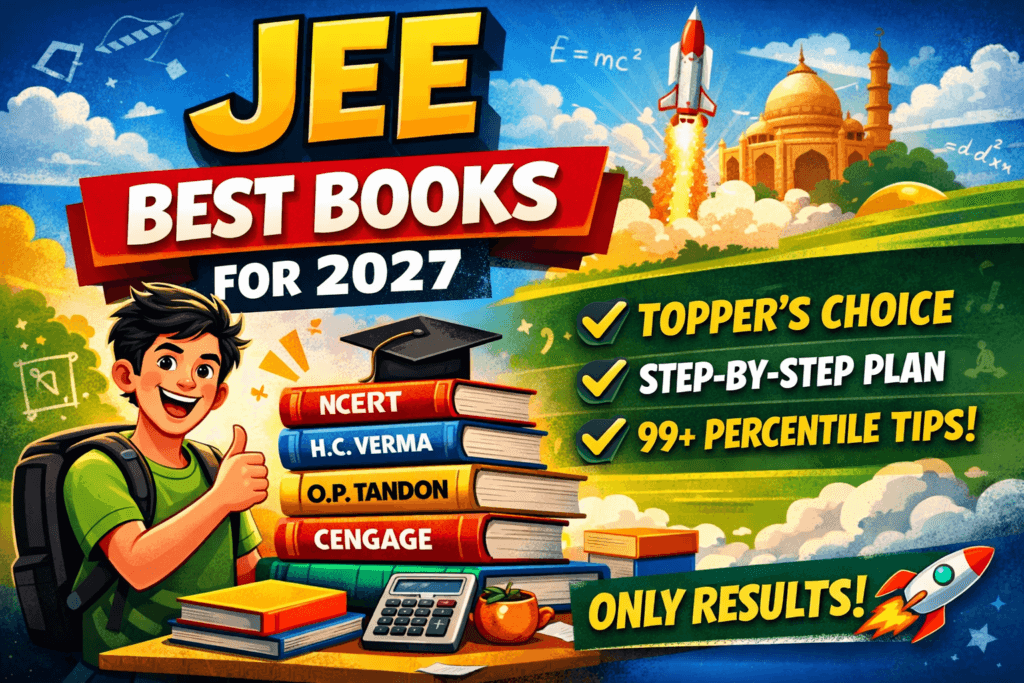
Q2: Advanced ke liye sabse important book kaunsi hai? Foundation ke liye NCERT, Physics ke liye H.C. Verma, Chemistry ke liye O.P. Tandon/P. Bahadur, aur Maths ke liye Cengage/Arihant series best hain.
Q3: Kya Inorganic Chemistry skip kar sakte hain? Bilkul nahi! Inorganic sabse scoring hoti hai aur kam time leti hai. Iska weightage lagbhag 30-33% hota hai.
Q4: Calculus ka weightage kitna hota hai? Maths ke paper mein Calculus akela 35-40% tak cover kar sakta hai. Isse skip karna “suicidal” ho sakta hai.
Q5: ExamGril syllabus tracker kaise help karega? ExamGril par humne topic-wise checklists banayi hain jinhe aap solve karne ke baad tick kar sakte hain, taaki koi bhi ‘deep topic’ miss na ho.
Q6: Negative marking se kaise bachein? Sirf wahi questions attempt karein jahan aap 90% confident hon. Advanced mein partial marking bhi hoti hai, uska fayda uthayein.
Q7: Kya NCERT Physics Advanced ke liye kafi hai? Conceptual understanding ke liye acchi hai, lekin numerical level ke liye aapko Irodov ya H.C. Verma solve karni padegi.
Q8: Organic Chemistry ke mechanisms kaise yaad karein? Mechanisms ko “ratta” mat mariye. Electron movement (arrows) ki logic samjhiye. Flowcharts banayein.
Q9: 3D Geometry aur Vectors kitne marks dilate hain? Ye section lagbhag 10-12% weightage rakhta hai aur relatively scoring hota hai agar aapki visualization acchi hai.
Q10: ExamGril ka “Launch Day” kab hai? Hamara official platform 4th May 2026 ko launch ho raha hai, jahan aapko in sabhi topics ke detailed video solutions milenge!
Summary Table: Syllabus Overview
| Feature | Details |
| Exam Mode | Computer Based Test (CBT) |
| Papers | Paper 1 & Paper 2 (Both Compulsory) |
| Question Types | MCQ, Numerical Value, Integer, Multiple Correct |
| Focus | Deep Conceptual Application |
To crack JEE Advanced, you don’t need to study 24 hours. You need to study 8-10 hours with 100% focus on the syllabus depth. All the best, Future IITians!
Dream Pura karne ke liye Aapko 3 steps Follow krna hai
Step 1: Base (Strong) Karo!
Sabse pehle samajhiye ki aap lad kis se rahe hain. JEE sirf ek exam nahi hai, ye aapki problem-solving speed aur mental toughness ka test hai. Agar aapko basics hi nahi pata—ki eligibility kya hai, attempts kitne milte hain, aur pattern kya hai—toh aap pehli seedhi kaise chadhenge?
👉 Start here: What is JEE Exam? From Zero to IIT Hero
Step 2: Sahi “Hathyaar” Pick Karo (Best Books)
War jeetne ke liye talwar nahi, sahi talwar chahiye hoti hai. JEE ki duniya mein hazaron books hain, lekin har book aapko 99+ Percentile tak nahi le jayegi. Concepts ke liye NCERT zaroori hai, lekin Advanced level ki gehrai (depth) ke liye aapko specialized resources chahiye.
👉 Check out our curated list: JEE Best Books for 2027 – 99+ Percentile Guide
Step 3: Execution – Strategy Jo Kaam Kare
Syllabus pata hai, books table par hain… ab kya? Ab aati hai baari Strategy ki. Kab kaunsa subject padhna hai? Mock tests kab dene hain? Aur sabse bada sawal—backlog kaise cover karein? Ek topper aur ek average student ke beech ka farq sirf ek “Systematic Plan” hota hai.
👉 Read the Master Plan: How to Crack JEE Mains 2027 Exam – Complete Strategy Guide