Chemistry is one of the highest-scoring subjects in the NEET exam. Students who prepare Chemistry smartly can easily score 140–170 marks because a large portion of questions are directly NCERT-based.
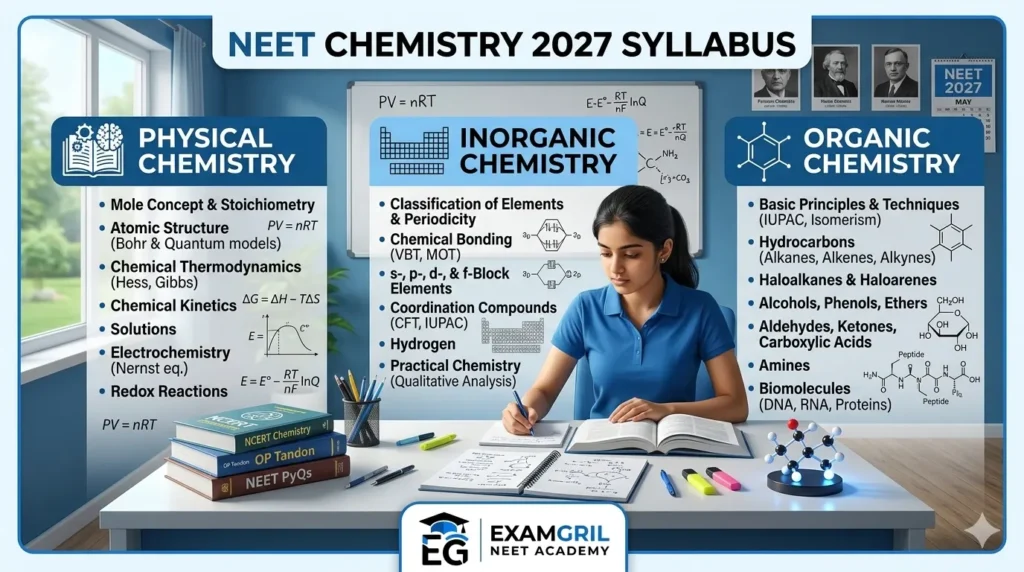
The NEET Chemistry Syllabus 2027 includes topics from both Class 11 and Class 12 NCERT Chemistry books. The syllabus is broadly divided into:
- Physical Chemistry
- Organic Chemistry
- Inorganic Chemistry
As per recent NEET trends, NCERT line-by-line preparation is extremely important for Chemistry.
Also Read: NEET 2027 Full Syllabus (Subject-Wise Detailed Guide) to understand the latest Physics, Chemistry, and Biology topics along with deleted chapters and preparation strategy.
Table of Contents
NEET Chemistry Syllabus 2027 Overview
| Particulars | Details |
|---|---|
| Exam Name | NEET UG 2027 |
| Conducting Authority | NTA |
| Subject | Chemistry |
| Total Questions | 45 Questions |
| Total Marks | 180 Marks |
| Question Type | MCQ |
| Syllabus Source | NCERT Class 11 & 12 |
| Difficulty Level | Moderate to Difficult |
NEET Chemistry Syllabus 2027 PDF Download
Students should always prepare according to the latest official syllabus released by NTA/NMC.
👉 Download the official syllabus PDF from the official NMC website once released.
“Official NEET 2027 Syllabus PDF“
NEET Chemistry Syllabus 2027 – Class 11 Chapters
Physical Chemistry (Class 11)
| Unit | Important Topics |
|---|---|
| Some Basic Concepts of Chemistry | Mole Concept, Stoichiometry, Concentration Terms |
| Structure of Atom | Quantum Numbers, Bohr Model, Electronic Configuration |
| Thermodynamics | Enthalpy, Entropy, Gibbs Energy |
| Equilibrium | Ionic Equilibrium, pH, Buffer Solutions |
| Redox Reactions | Oxidation Number, Balancing Reactions |
Inorganic Chemistry (Class 11)
| Unit | Important Topics |
|---|---|
| Classification of Elements | Periodic Trends |
| Chemical Bonding | Hybridization, MOT, VSEPR Theory |
| Hydrogen | Properties & Compounds |
| s-Block Elements | Alkali & Alkaline Earth Metals |
Organic Chemistry (Class 11)
| Unit | Important Topics |
|---|---|
| Organic Chemistry Basics | IUPAC, Resonance, Inductive Effect |
| Hydrocarbons | Alkanes, Alkenes, Alkynes |
| Environmental Chemistry | Pollution & Green Chemistry |
NEET Chemistry Syllabus 2027 – Class 12 Chapters
Physical Chemistry (Class 12)
| Unit | Important Topics |
|---|---|
| Solutions | Colligative Properties |
| Electrochemistry | Nernst Equation, Conductance |
| Chemical Kinetics | Rate Laws, Arrhenius Equation |
Inorganic Chemistry (Class 12)
| Unit | Important Topics |
|---|---|
| p-Block Elements | Group 15–18 |
| d & f Block Elements | Transition Elements |
| Coordination Compounds | Bonding, Isomerism |
Organic Chemistry (Class 12)
| Unit | Important Topics |
|---|---|
| Haloalkanes & Haloarenes | Reaction Mechanisms |
| Alcohols, Phenols & Ethers | Reactions & Conversions |
| Aldehydes & Ketones | Named Reactions |
| Amines | Diazonium Salts |
| Biomolecules | Proteins, Vitamins |
| Practical Chemistry | Salt Analysis, Experiments |
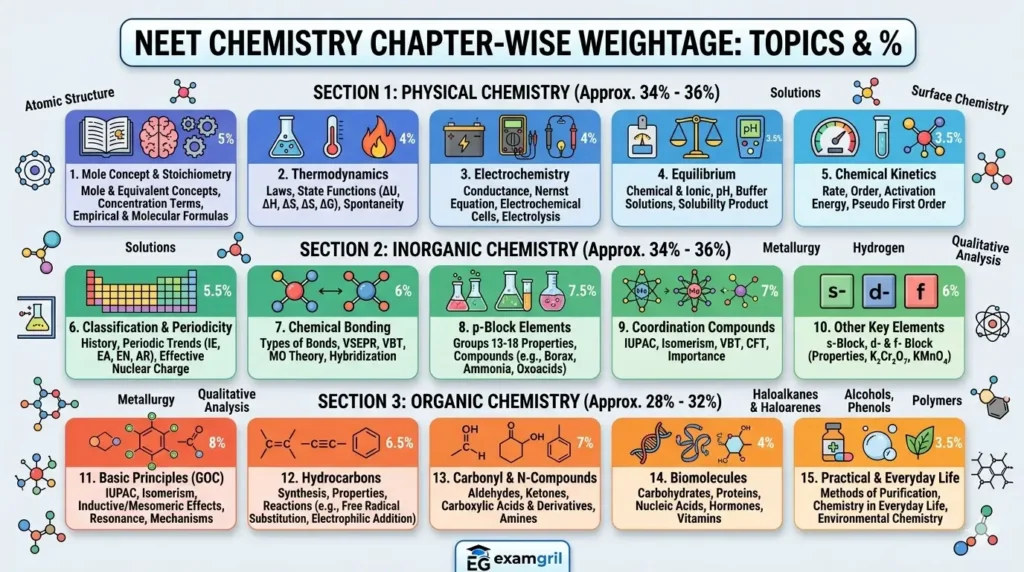
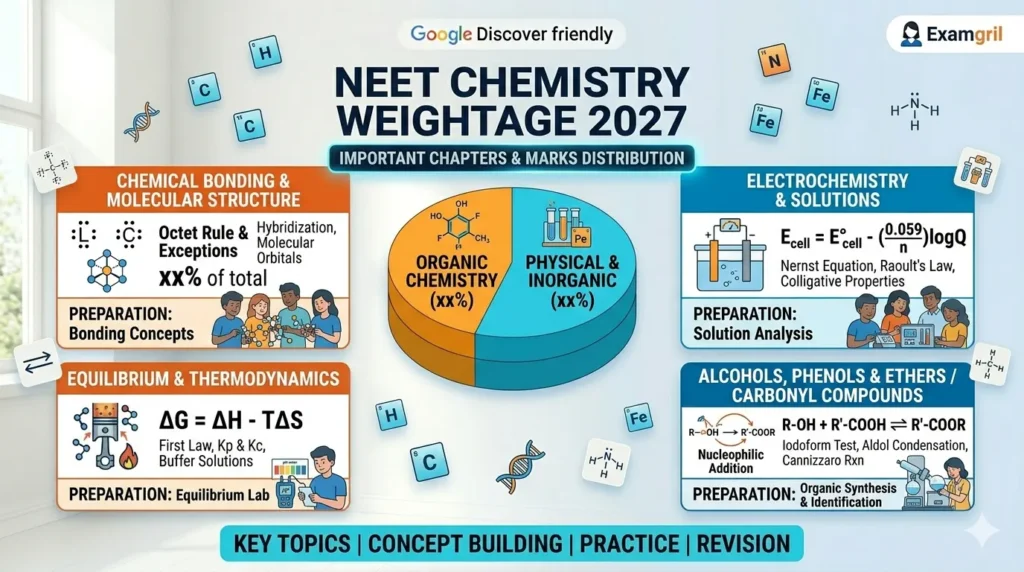
Chapter-Wise Weightage for NEET Chemistry 2027
| Chapter | Expected Weightage |
|---|---|
| Chemical Bonding | High |
| Coordination Compounds | High |
| Thermodynamics | High |
| Equilibrium | High |
| Electrochemistry | High |
| Organic Chemistry GOC | Very High |
| Biomolecules | Medium |
| Chemical Kinetics | High |
| Hydrocarbons | Medium |
| Solutions | Medium |
Recent PYQ trends also show repeated focus on Chemical Bonding, Coordination Compounds, Thermodynamics, and Organic Chemistry mechanisms.
NEET Chemistry Deleted Topics 2027
Some topics removed or reduced in recent NEET patterns include:
- Polymers
- Chemistry in Everyday Life
- Hydrogen (partially reduced relevance)
- Environmental Chemistry (reduced weightage)
Students should still verify the latest official syllabus before preparation.
Best Preparation Strategy for NEET Chemistry 2027
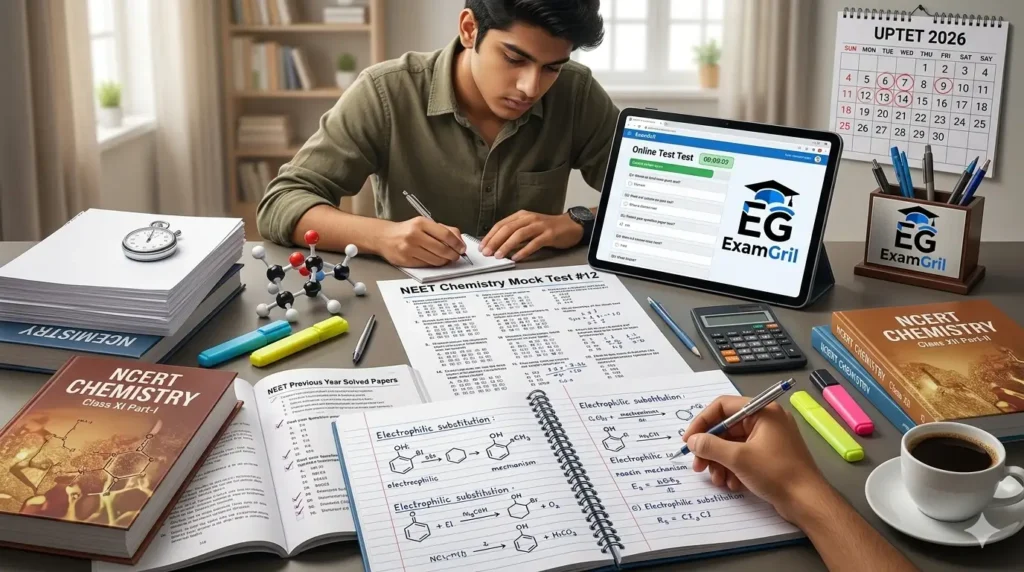
1. Complete NCERT First
Most NEET Chemistry questions are directly based on NCERT concepts and statements.
2. Focus on High-Weightage Chapters
Prioritize:
- Chemical Bonding
- Coordination Compounds
- Thermodynamics
- Equilibrium
- Electrochemistry
- Organic Reaction Mechanisms
Community discussions and toppers’ strategies also emphasize these chapters repeatedly.
3. Practice PYQs Daily
Solve at least:
- 50 MCQs daily
- Last 10 years PYQs
- Chapter-wise mock tests
4. Make Short Notes
Especially for:
- Organic reactions
- Named reactions
- Inorganic exceptions
- Formula sheets
5. Revise Multiple Times
Chemistry requires:
- Fast revision
- Reaction memorization
- Formula recall
📘 Preparing for all subjects together? Check the updated NEET Physics Syllabus 2027 with chapter-wise weightage, important formulas, and preparation tips.
Best Books for NEET Chemistry syllabus 2027
| Subject | Best Books |
|---|---|
| Physical Chemistry | NCERT + OP Tandon |
| Organic Chemistry | NCERT + MS Chauhan |
| Inorganic Chemistry | NCERT Line-by-Line |
| Mock Tests | Previous Year Papers |
NEET Chemistry Preparation Tips by Toppers
- Read NCERT daily
- Revise Organic Chemistry regularly
- Practice Physical Chemistry numericals daily
- Memorize Inorganic Chemistry from NCERT only
- Give weekly mock tests
- Analyze mistakes after every test
Many successful aspirants follow strict revision + PYQ analysis routines instead of constantly changing resources.
Common Mistakes Students Make in Chemistry
❌ Ignoring NCERT
❌ Avoiding Physical Chemistry numericals
❌ Not revising Organic reactions
❌ Using too many books
❌ Skipping PYQs
❌ Ignoring mock test analysis
90-Day Revision Plan for NEET Chemistry 2027
| Duration | Goal |
|---|---|
| First 30 Days | Complete High-Weightage Chapters |
| Next 30 Days | PYQs + Mock Tests |
| Final 30 Days | Revision + Weak Topics |
Why Chemistry Can Become Your Highest Scoring Subject
Compared to Physics, Chemistry is:
- More predictable
- More NCERT-based
- Easier to revise quickly
- Faster to solve in exams
Students with strong Chemistry preparation often gain a major rank advantage.
NEET Chemistry Syllabus 2026 FAQs
Is NCERT enough for NEET Chemistry 2027?
Yes, NCERT is the most important resource for NEET Chemistry preparation.
Which Chemistry section is easiest in NEET?
Inorganic Chemistry is considered easiest if prepared from NCERT properly.
How many chapters are there in NEET Chemistry 2027?
There are around 20 major units from Class 11 and 12 Chemistry.
Which chapter has highest weightage in NEET Chemistry?
Chemical Bonding, Coordination Compounds, Thermodynamics, and Organic Chemistry mechanisms usually carry high weightage.
How to score 160+ in NEET Chemistry?
Focus on:
- NCERT mastery
- PYQs
- Regular revision
- Mock tests
- Formula practice
Conclusion
The NEET Chemistry Syllabus 2027 is heavily based on NCERT Class 11 and 12 Chemistry. Students who follow a smart preparation strategy with consistent revision, PYQ practice, and mock tests can easily achieve excellent marks.
Instead of studying too many resources, focus on:
- NCERT mastery
- High-weightage chapters
- Daily practice
- Revision consistency
That is the real key to scoring high in NEET Chemistry.
The 90-day revision plan you outlined seems like an excellent way to stay organized and focused. Pairing that with daily practice of previous year questions could really strengthen understanding and improve accuracy. Breaking down the syllabus chapter-wise also makes tackling Chemistry feel much more manageable.
The emphasis on chapter-wise weightage alongside the deleted topics is a huge help for students trying to optimize their revised 2027 strategy. I particularly agree with the ’90-Day Revision Plan’ approach, as consistent short-note reviews are often the key to retaining those tricky NCERT facts in Organic and Inorganic sections.