If you want to crack the Uttar Pradesh Teacher Eligibility Test (UPTET), understanding the latest syllabus and exam pattern is the first step. Most aspirants start preparation without knowing the exact topic-wise weightage, important sections, or scoring strategy — and that becomes the biggest reason for low scores.
Want to know the official application dates, exam schedule, and latest updates? Check the complete UPTET Notification 2026 guide here.
In this detailed guide, you will get:
Table of Contents
What is UPTET?
The Uttar Pradesh Teacher Eligibility Test (UPTET) is a state-level eligibility examination conducted for candidates who want to become teachers in Uttar Pradesh government and aided schools.
The exam is divided into two papers:
| Paper | Teaching Level |
|---|---|
| Paper 1 | Classes 1 to 5 (Primary Teacher) |
| Paper 2 | Classes 6 to 8 (Upper Primary Teacher) |
Candidates who want to teach both levels must appear for both papers.
UPTET 2026 Overview
| Particulars | Details |
|---|---|
| Exam Name | Uttar Pradesh Teacher Eligibility Test |
| Short Name | UPTET |
| Exam Level | State-Level |
| Mode of Exam | Offline |
| Question Type | MCQ |
| Total Questions | 150 |
| Total Marks | 150 |
| Duration | 2 Hours 30 Minutes |
| Negative Marking | No |
| Official Website | updeled.gov.in |
| Language | Hindi & English |
UPTET Exam Pattern 2026
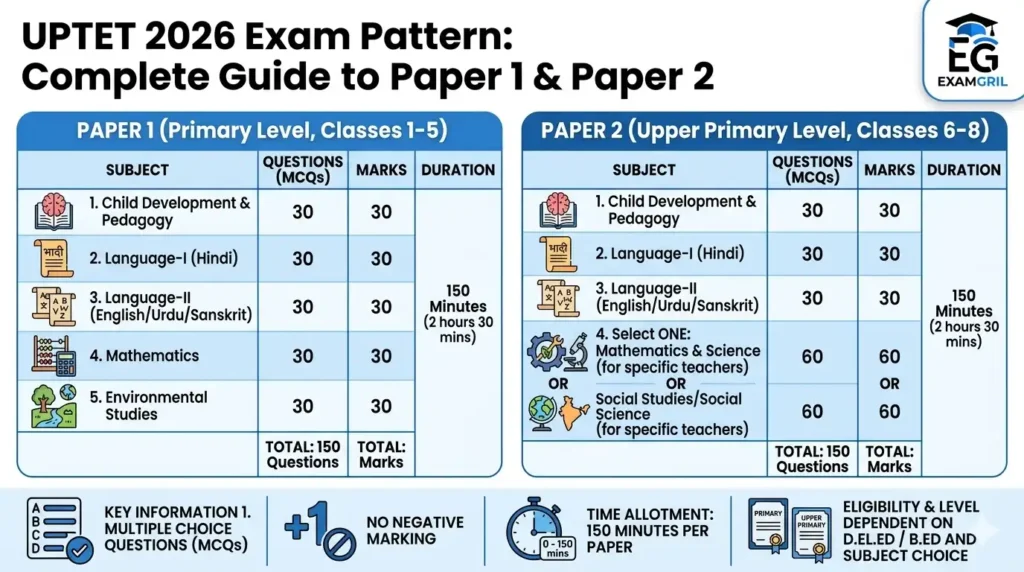
Understanding the exam pattern helps you:
- Know section weightage
- Improve time management
- Focus on scoring topics
- Avoid unnecessary preparation
One major advantage in UPTET is no negative marking, which means candidates should attempt all questions.
UPTET Paper 1 Exam Pattern 2026
Paper 1 is conducted for candidates who want to teach Classes 1 to 5.
| Subject | Questions | Marks |
|---|---|---|
| Child Development & Pedagogy | 30 | 30 |
| Language I | 30 | 30 |
| Language II | 30 | 30 |
| Mathematics | 30 | 30 |
| Environmental Studies | 30 | 30 |
| Total | 150 | 150 |
Important Points
- Duration: 150 Minutes
- Each question carries 1 mark
- No negative marking
- Objective type questions only
UPTET Paper 2 Exam Pattern 2026
Paper 2 is for candidates who want to teach Classes 6 to 8.
| Subject | Questions | Marks |
|---|---|---|
| Child Development & Pedagogy | 30 | 30 |
| Language I | 30 | 30 |
| Language II | 30 | 30 |
| Mathematics & Science OR Social Science | 60 | 60 |
| Total | 150 | 150 |
Candidates from Science background choose Mathematics & Science while Arts candidates choose Social Science.
UPTET Marking Scheme
| Criteria | Marks |
|---|---|
| Correct Answer | +1 |
| Wrong Answer | 0 |
| Unattempted | 0 |
| Negative Marking | No |
UPTET Syllabus 2026 (Detailed)
Below is the latest subject-wise syllabus based on previous notifications and current exam trends.
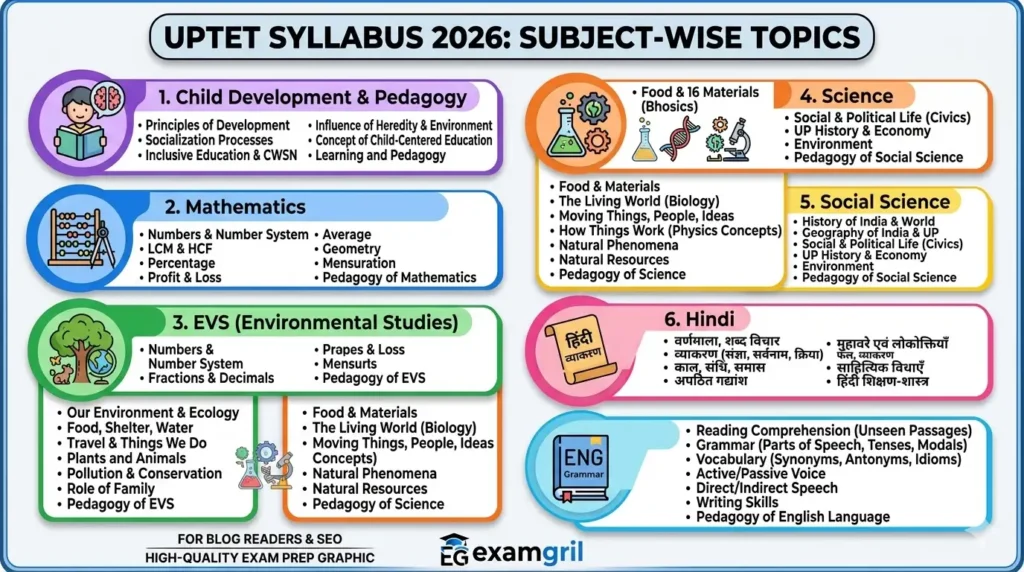
Child Development & Pedagogy Syllabus
This section is common in both Paper 1 and Paper 2 and is considered one of the highest-scoring sections.
Important Topics
- Concept of Growth & Development
- Learning Theories
- Piaget Theory
- Vygotsky Theory
- Kohlberg Theory
- Inclusive Education
- Child-Centered Learning
- Intelligence & Creativity
- Teaching Methods
- Motivation
- Personality
- Classroom Management
- Assessment & Evaluation
- Learning Difficulties
- RTE Act 2009
High Weightage Topics
| Topic | Expected Questions |
|---|---|
| Learning Theories | 5-7 |
| Inclusive Education | 3-5 |
| Pedagogy | 8-10 |
| Child Psychology | 5-6 |
Language I & Language II Syllabus
The language section checks grammar, comprehension, vocabulary, and pedagogy understanding.
Important Topics
- Reading Comprehension
- Grammar
- Vocabulary
- Sentence Formation
- Error Detection
- भाषा शिक्षण विधियाँ
- Unseen Passage
- Synonyms & Antonyms
- भाषा विकास
Preparation Tips
- Read newspapers daily
- Practice grammar rules
- Solve comprehension passages
- Focus on pedagogy-based questions
Mathematics Syllabus
The Mathematics section mainly covers NCERT-level concepts.
Important Topics
- Number System
- Fractions
- Decimals
- Ratio & Proportion
- Percentage
- Geometry
- Mensuration
- Time & Distance
- Profit & Loss
- Data Handling
- Algebra Basics
Most Important Chapters
| Chapter | Difficulty |
|---|---|
| Geometry | Medium |
| Fractions | Easy |
| Data Handling | Easy |
| Percentage | Medium |
Environmental Studies (EVS) Syllabus
EVS is included only in Paper 1.
Important Topics
- Environment
- Family & Friends
- Food & Nutrition
- Water
- Pollution
- Solar System
- Plants & Animals
- Transportation
- Human Body
- Health & Hygiene
- Natural Resources
Best Strategy for EVS
- Read NCERT Books
- Learn diagrams
- Revise factual topics regularly
- Practice MCQs daily
Science Syllabus (Paper 2)
Science is applicable for Mathematics & Science candidates.
Physics Topics
- Motion
- Force
- Pressure
- Heat
- Light
- Sound
- Electricity
Chemistry Topics
- Acids & Bases
- Metals & Non-Metals
- Atoms & Molecules
- Chemical Reactions
Biology Topics
- Human Body
- Nutrition
- Diseases
- Reproduction
- Environment
Social Science Syllabus (Paper 2)
Applicable for Social Science candidates.
History Topics
- Ancient India
- Medieval India
- Modern India
- Freedom Movement
Geography Topics
- Earth
- Resources
- Climate
- Agriculture
- Maps
Political Science
- Constitution
- Democracy
- Parliament
- Fundamental Rights
Economics
- Indian Economy
- Banking
- Budget
- Development
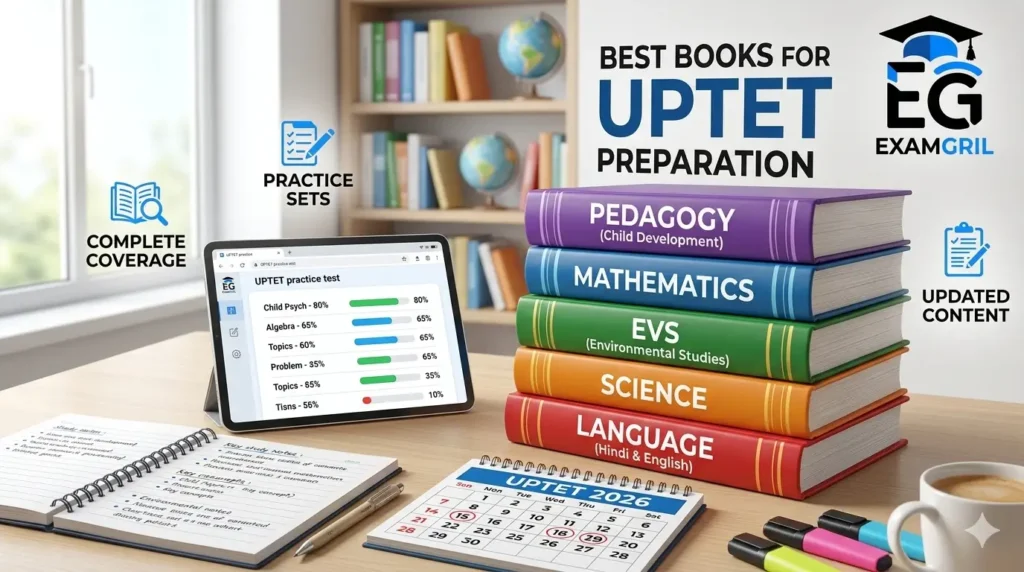
Best Books for UPTET Preparation
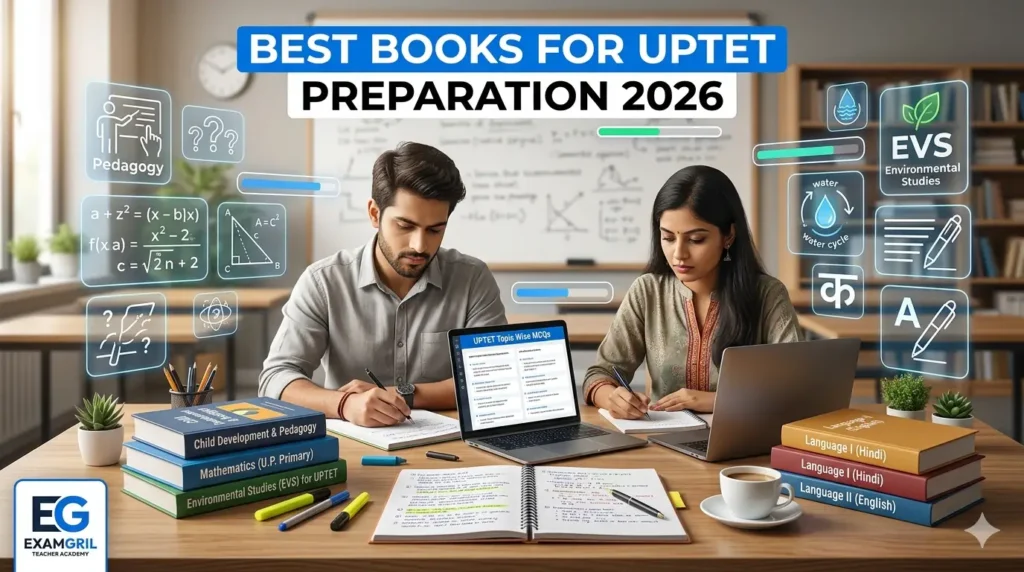
| Subject | Recommended Book |
|---|---|
| Child Development | Arihant CTET & TET |
| Mathematics | NCERT + RS Aggarwal |
| EVS | NCERT EVS Books |
| Science | Lucent General Science |
| Social Science | NCERT SST |
| Pedagogy | Disha Publication |
Confused about study material? Explore the complete list of Best Books for UPTET Preparation recommended by experts.
Best Preparation Strategy to Crack UPTET
1. Understand the Syllabus First
Do not study random topics. Follow the official syllabus strictly.
2. Focus on Pedagogy
Pedagogy questions dominate the paper and are scoring.
3. Solve Previous Year Papers
Previous year questions help understand:
- Question pattern
- Difficulty level
- Important topics
- Time management
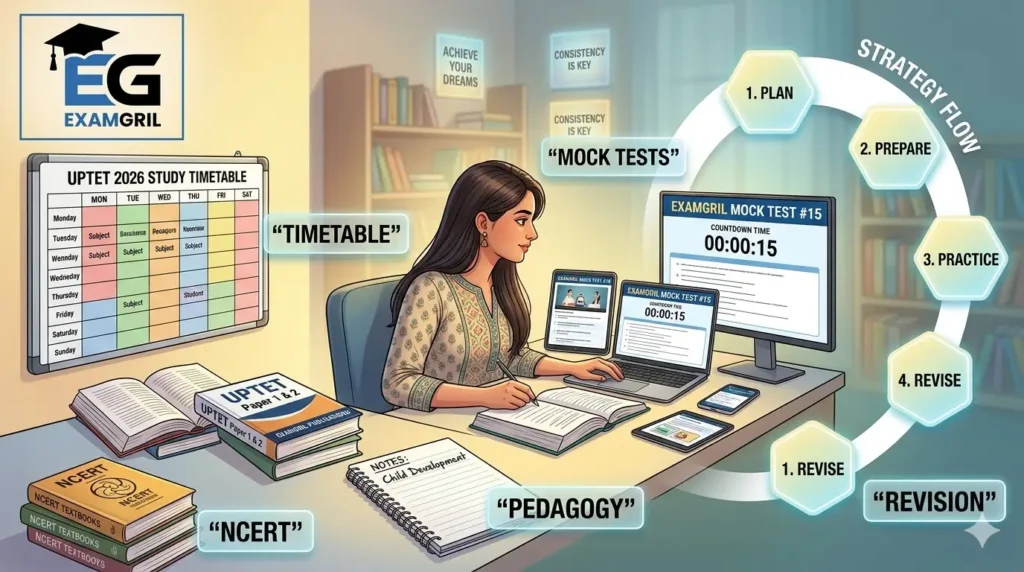
4. Attempt Mock Tests
Weekly mock tests improve:
- Speed
- Accuracy
- Confidence
5. Revise Daily
Without revision, retention becomes weak.
30-Day UPTET Study Plan
| Week | Focus Area |
|---|---|
| Week 1 | Child Development + Language |
| Week 2 | Mathematics + EVS |
| Week 3 | Science / Social Science |
| Week 4 | Mock Tests + Revision |
Common Mistakes Students Must Avoid
- Ignoring pedagogy
- Not solving mock tests
- Skipping revision
- Studying without a timetable
- Ignoring NCERT books
Why Understanding the UPTET Syllabus is Important?
A proper understanding of the syllabus helps candidates:
- Save preparation time
- Focus on important chapters
- Improve accuracy
- Avoid irrelevant topics
- Build a smart preparation strategy
UPTET Qualifying Marks
| Category | Minimum Qualifying Marks |
|---|---|
| General | 60% |
| OBC/SC/ST | Relaxation as per rules |
Expert Tips to Score 120+ Marks in UPTET
- Complete NCERT thoroughly
- Focus on pedagogy daily
- Attempt full-length mocks
- Revise short notes regularly
- Improve accuracy instead of guessing
FAQs
Is there negative marking in UPTET?
No, there is no negative marking.
How many papers are there in UPTET?
There are two papers — Paper 1 and Paper 2.
What is the duration of UPTET exam?
The duration is 2 hours 30 minutes.
Is NCERT enough for UPTET?
NCERT books are very important and cover a large portion of the syllabus.
Can I prepare for UPTET in 2 months?
Yes, with proper strategy and daily study, it is possible.
The breakdown of subjects and important topics in this guide is really helpful. I’ve found that noting which chapters frequently appear in past exams makes targeted revision much more effective. Combining that with a daily study routine seems like a smart way to tackle UPTET preparation efficiently.
This breakdown of the Chapter-wise weightage for Paper 1 and 2 is a game-changer, especially the emphasis on starting with Pedagogy and child development. Focusing on NCERT for the core subjects along with the suggested 30-day revision plan seems like a solid strategy to avoid the common pitfalls many aspirants face. Thanks for sharing such a structured guide to tackle the 2026 exam.