The Central Teacher Eligibility Test (CTET) is one of the most important teaching eligibility examinations in India conducted by the Central Board of Secondary Education. Every year lakhs of candidates appear in the examination to become eligible for teaching jobs in Kendriya Vidyalayas, Navodaya Vidyalayas, Central Government Schools, and many private schools.
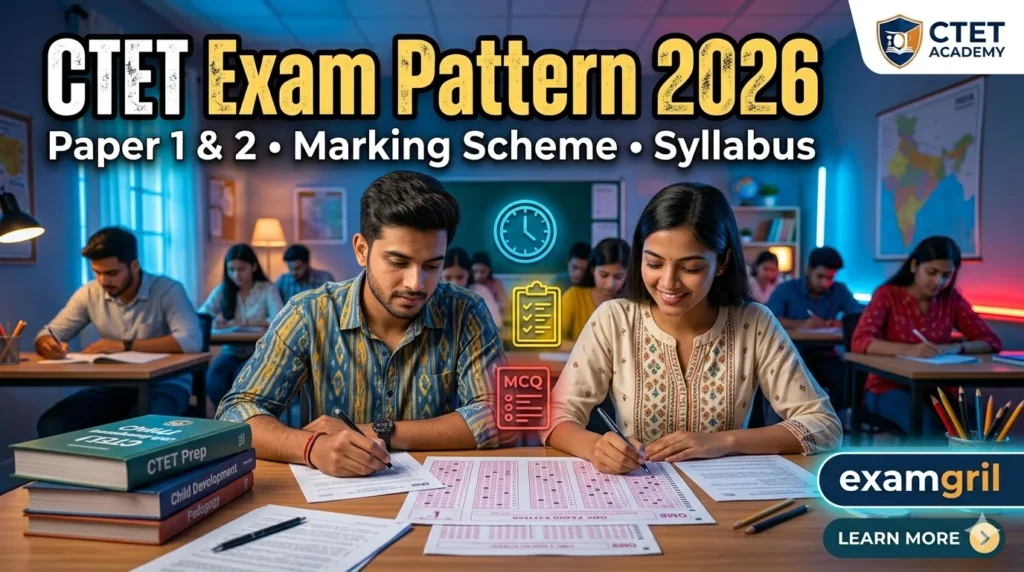
Understanding the CTET Exam Pattern 2026 is the first step toward effective preparation. Candidates who clearly know the structure of the examination can manage their preparation strategy, time allocation, and subject focus more efficiently.
According to the latest updates available on the official CTET portal and major education platforms, the CTET 2026 examination will consist of two papers:
- Paper 1 for Classes 1 to 5
- Paper 2 for Classes 6 to 8
Candidates who wish to teach Classes 1 to 8 must appear in both papers.
👉 Want complete details about application dates, exam schedule, and latest updates? Check the full CTET 2026 Notification here.
CTET Exam Pattern 2026 Overview
| Particulars | Details |
|---|---|
| Exam Name | CTET 2026 |
| Conducting Body | CBSE |
| Exam Mode | Offline (OMR Based) |
| Question Type | Multiple Choice Questions (MCQs) |
| Number of Papers | 2 Papers |
| Duration | 2 Hours 30 Minutes |
| Total Questions | 150 Questions |
| Maximum Marks | 150 Marks |
| Negative Marking | No Negative Marking |
| Official Website | CTET Official Website |
| Language Mode | Bilingual (Hindi & English) |
The exam pattern mainly focuses on pedagogy, child psychology, language comprehension, subject understanding, and teaching aptitude.
✅ Before preparing for the exam, make sure you meet the latest CTET Eligibility 2026 criteria for Paper 1 and Paper 2.
CTET Exam Pattern 2026 Highlights
Important Features of CTET Exam
- Both papers contain objective-type questions.
- Each question carries 1 mark.
- No negative marking for wrong answers.
- The examination is conducted in offline mode using OMR sheets.
- Candidates can choose two languages from the available options.
- The difficulty level is based on NCERT curriculum standards.
CTET Paper 1 Exam Pattern 2026
CTET Paper 1 is conducted for candidates who want to become teachers for Classes 1 to 5.
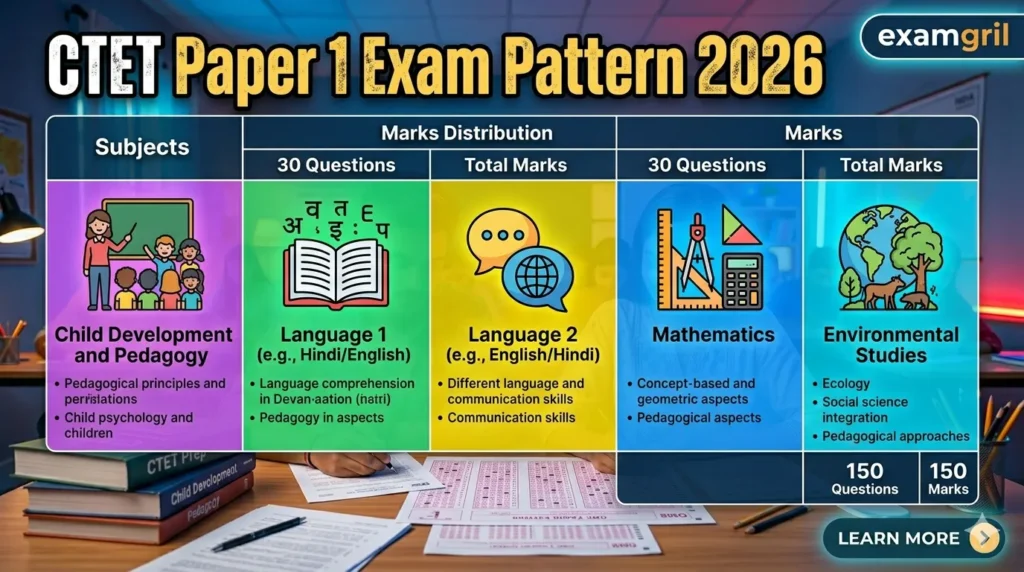
The paper contains five major sections:
- Child Development and Pedagogy
- Language I
- Language II
- Mathematics
- Environmental Studies
CTET Paper 1 Subject Wise Marks Distribution
| Subjects | Questions | Marks |
|---|---|---|
| Child Development & Pedagogy | 30 | 30 |
| Language I | 30 | 30 |
| Language II | 30 | 30 |
| Mathematics | 30 | 30 |
| Environmental Studies | 30 | 30 |
| Total | 150 | 150 |
Detailed Analysis of CTET Paper 1
1. Child Development & Pedagogy
This section evaluates understanding of child psychology, learning processes, inclusive education, and teaching methodologies.
Important Topics
- Child Development
- Learning Theories
- Inclusive Education
- Assessment and Evaluation
- Teaching Methods
This section is considered highly scoring because conceptual questions are repeated frequently.
2. Language I
Language I focuses on proficiency in the medium of instruction chosen by the candidate.
Major Areas
- Reading Comprehension
- Grammar
- Vocabulary
- Pedagogy of Language Development
3. Language II
Language II is generally different from Language I and tests communication and comprehension abilities.
Topics Covered
- Grammar
- Reading Skills
- Language Teaching Methods
- Sentence Structure
4. Mathematics
The Mathematics section tests conceptual understanding and pedagogy.
Major Topics
- Number System
- Geometry
- Data Handling
- Fractions
- Time & Distance
- Pedagogical Issues
5. Environmental Studies
Environmental Studies focuses on classroom teaching methodology and subject knowledge.
Important Topics
- Family & Friends
- Food & Shelter
- Transportation
- Natural Resources
- EVS Pedagogy
CTET Paper 2 Exam Pattern 2026
CTET Paper 2 is designed for candidates who want to teach Classes 6 to 8.
The structure is slightly different from Paper 1 because it includes subject specialization.
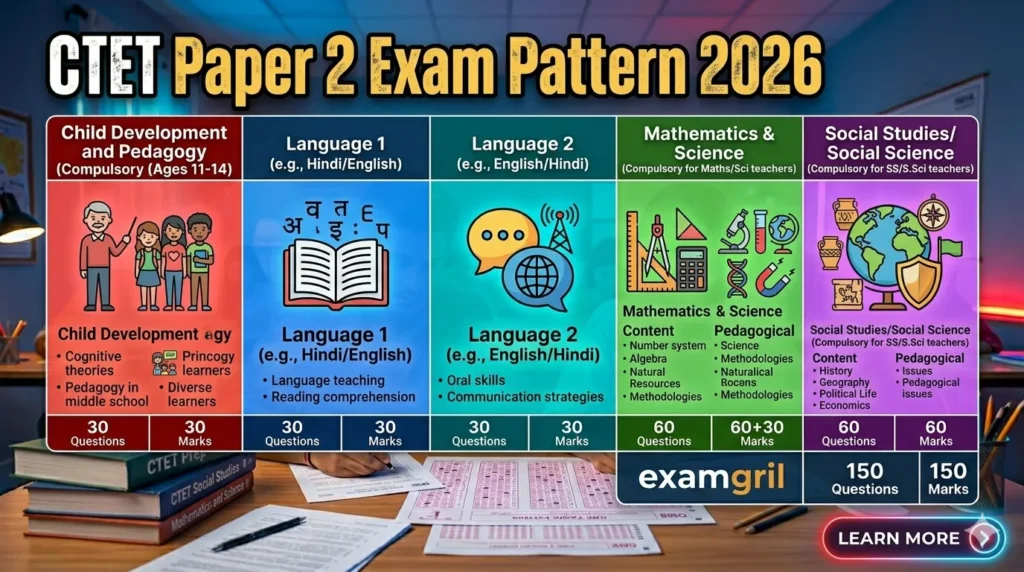
CTET Paper 2 Subject Wise Distribution
| Subjects | Questions | Marks |
|---|---|---|
| Child Development & Pedagogy | 30 | 30 |
| Language I | 30 | 30 |
| Language II | 30 | 30 |
| Mathematics & Science OR Social Studies/Social Science | 60 | 60 |
| Total | 150 | 150 |
Mathematics & Science Section
Candidates who want to become Mathematics or Science teachers must choose this section.
Important Topics
- Algebra
- Geometry
- Physics Basics
- Chemistry Basics
- Biology Concepts
- Pedagogy
Social Studies/Social Science Section
Candidates aiming for Social Science teaching posts should choose this option.
Major Topics
- History
- Geography
- Political Science
- Economics
- Social Science Pedagogy
CTET Marking Scheme 2026
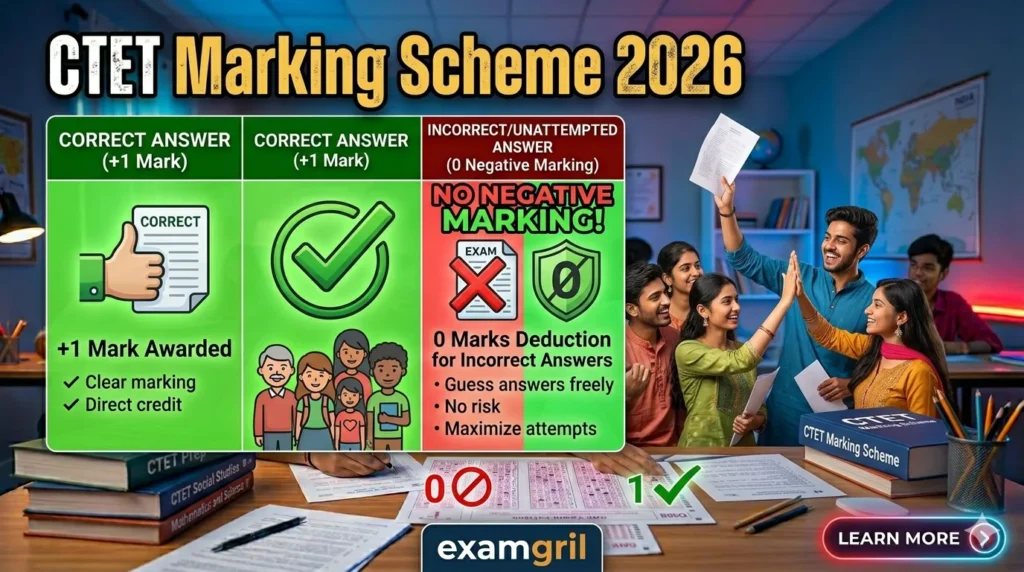
The CTET marking scheme is straightforward and student-friendly.
| Response Type | Marks |
|---|---|
| Correct Answer | +1 |
| Wrong Answer | 0 |
| Unattempted | 0 |
Important Point
There is absolutely no negative marking in CTET. Candidates should attempt all questions because there is no penalty for incorrect answers.
CTET Exam Duration 2026
| Paper | Duration |
|---|---|
| Paper 1 | 2 Hours 30 Minutes |
| Paper 2 | 2 Hours 30 Minutes |
Candidates appearing for both papers need to manage their stamina and concentration effectively.
CTET Language Options
CTET offers multiple language options. Candidates must choose:
- One language as Language I
- Another language as Language II
The language selection should be done carefully during application submission.
CTET Qualifying Marks 2026
General Category
- 60% Marks
- 90 out of 150
Reserved Categories
- 55% Marks
- 82 out of 150 (approximately)
Qualifying CTET does not guarantee a teaching job but makes candidates eligible to apply for teaching vacancies.
CTET Exam Mode 2026
The CTET exam is conducted in offline mode using OMR sheets.
Important Instructions
- Use blue or black ballpoint pen.
- Fill circles carefully.
- Avoid overwriting.
- Carry admit card and valid ID proof.
CTET Difficulty Level
The overall difficulty level of CTET is considered:
| Paper | Difficulty |
|---|---|
| Paper 1 | Easy to Moderate |
| Paper 2 | Moderate |
Questions are mainly conceptual and pedagogy-based rather than calculation-heavy.
Best Preparation Strategy for CTET Exam Pattern 2026
1. Understand the Syllabus First
Candidates should complete the syllabus topic-wise according to the exam pattern.
📚 Now that you understand the exam structure, download the complete CTET Syllabus 2026 and start topic-wise preparation.
2. Solve Previous Year Papers
Previous year papers help understand:
- Repeated topics
- Question level
- Time management
- Pedagogy pattern
3. Focus on Pedagogy
Pedagogy carries high weightage in both papers.
Important pedagogy sections:
- Child Psychology
- Inclusive Education
- Teaching Methods
- Learning Theories
4. Practice Mock Tests
Mock tests improve:
- Accuracy
- Speed
- Confidence
- OMR handling
CTET Paper 1 vs Paper 2
| Feature | Paper 1 | Paper 2 |
|---|---|---|
| Teaching Level | Classes 1 to 5 | Classes 6 to 8 |
| Difficulty | Easier | Moderate |
| Subject Focus | Basic Teaching | Subject Specialization |
| Subjects | EVS Included | Maths/Science or SST |
| Total Questions | 150 | 150 |
Common Mistakes Students Make in CTET
Ignoring Pedagogy
Pedagogy questions are highly important and scoring.
Not Solving Mock Tests
Many candidates fail because they never practice under exam conditions.
Poor Time Management
Spending too much time on difficult questions reduces overall attempts.
Ignoring NCERT Books
Most CTET questions are NCERT-based.
CTET Preparation Books
Best Books for CTET
- NCERT Books
- Child Development by Disha
- Arihant CTET Guide
- Lucent Pedagogy Notes
- Previous Year Papers
Why Understanding CTET Exam Pattern is Important
Knowing the exam pattern helps candidates:
- Build strategy
- Improve time management
- Understand important sections
- Identify scoring topics
- Increase accuracy
Students who prepare according to the latest exam pattern generally perform better in the examination.
CTET 2026 Important Official Resources
Conclusion
The CTET Exam Pattern 2026 is designed to evaluate candidates’ teaching aptitude, pedagogical understanding, and subject knowledge. Both Paper 1 and Paper 2 follow a structured format with 150 MCQs and no negative marking.
Candidates who thoroughly understand the exam structure, marking scheme, and subject-wise weightage can significantly improve their preparation strategy and scoring potential.
To crack CTET 2026 successfully, candidates should focus on:
- NCERT concepts
- Pedagogy
- Mock tests
- Previous year papers
- Time management
A proper understanding of the exam pattern combined with consistent practice can help candidates qualify the CTET examination with high scores.